What should you do after a pool-chemical spill?
A spill beside a pool is first a chemical-safety issue, not a stone-polishing problem. Keep people and pets away, avoid touching unidentified material and follow the product label and safety information. Contact the pool-service professional or appropriate emergency service if there are fumes, exposure or uncertainty. Do not add a cleaner, mix products or attempt to neutralize a spill with another chemical.
Only consider the appearance of the travertine after the area has been made safe by the appropriate person. This guide explains how to assess marks left behind; it is not a hazardous-spill cleanup procedure. A stone restoration visit does not replace chemical handling, pool-water management or an exposure assessment. Keep the product container or its details available without putting yourself at risk to retrieve them.
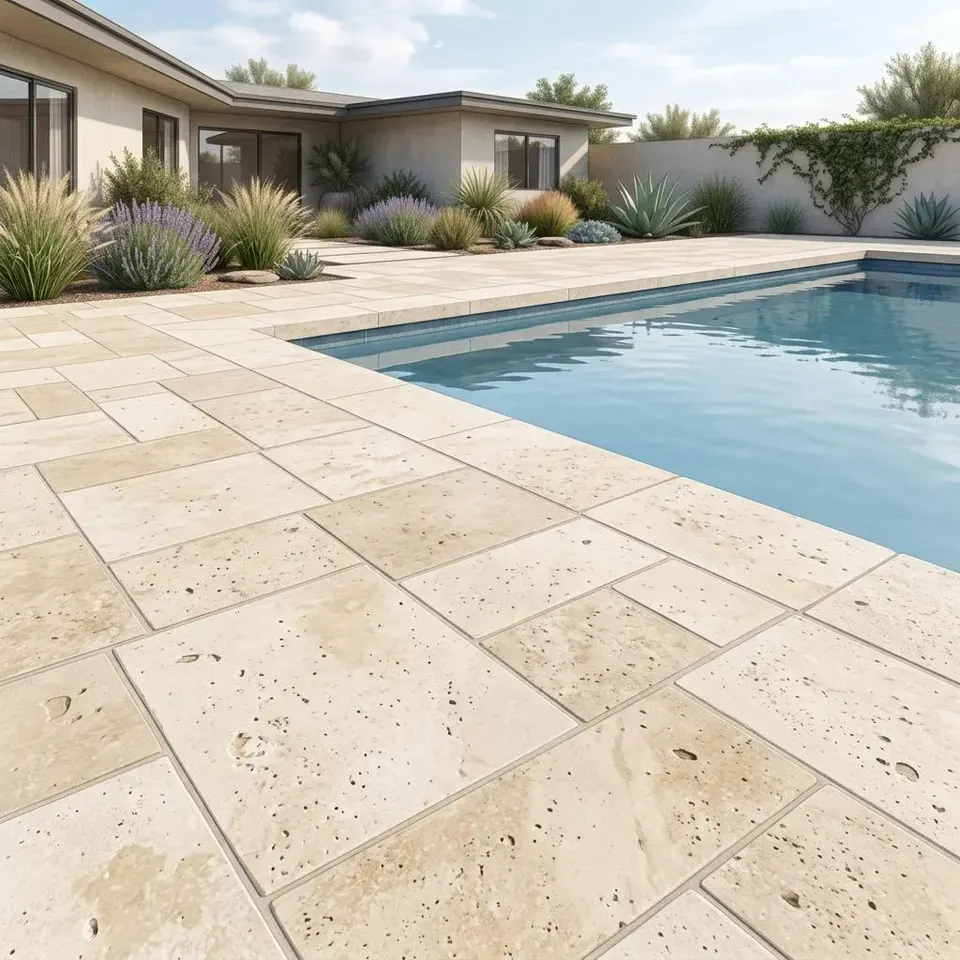
Why can travertine develop marks near a pool?
Travertine is a calcium-based natural stone, and acidic substances can alter its surface. Some pool-maintenance products require particular care around adjacent materials, but the effect depends on the actual formulation, concentration and contact. Do not assume that every pool chemical causes the same damage, or that a pale patch proves a chemical spill occurred.
Poolside stone can also show mineral deposits, soil, older coatings, moisture patterns and everyday wear. In a Los Angeles backyard, irrigation, landscape work and cleaning routines may all affect the same pavers. Record where a mark appears and what happened beforehand. The location can suggest useful questions, but it cannot establish the cause without reviewing the material and the surface.
Is the mark residue, a stain or acid etching?
Residue sits on the surface, staining changes the appearance within the material, and etching changes the stone's finish through a chemical reaction. A white deposit and a pale etched area can look similar from a distance. A surface can have more than one condition, so an assessor should avoid choosing a treatment solely from the color of the mark.
Once the area is safe and dry, take an overview and close photographs in normal daylight. Note whether the area feels different without scraping it or applying a test acid. Tell the restorer about previous sealers, cleaners and repair materials. A cleaned test area may help separate surface contamination from finish damage, but no photograph guarantees a complete diagnosis or an invisible repair.
When can routine stone cleaning help?
For ordinary soil after any chemical hazard has been resolved, the Natural Stone Institute recommends compatible neutral cleaners and clean equipment. Follow the cleaner's instructions and avoid over-concentration, which can leave a film. Keep runoff, nearby planting and the pool itself in the project plan. Do not treat routine cleaning advice as permission to wash an unresolved chemical spill into the pool or garden.
Avoid vinegar, acidic scale removers and aggressive scrubbing on calcium-based stone. A product intended for pool equipment or another tile material is not automatically suitable for travertine. Ask a professional to identify persistent deposits and specify a discreet test before broader treatment. Let the test area dry before evaluating its color and texture against adjacent pavers.
When does travertine need restoration rather than more cleaner?
If cleaning removes residue but leaves an altered texture or uneven reflection, surface refinement may be considered. Honing can be part of a restoration plan, but the appropriate method depends on the travertine, installation and existing finish. The goal is a suitable, consistent outdoor surface, not automatically the highest shine. Discuss how a treated area will blend with weathered neighboring stone.
Open holes, loose fill, cracks and raised edges need separate attention. A sealer cannot fill a void or stabilize a moving paver. Ask whether repairs are within the restoration scope and whether an installer or another trade must address underlying movement, drainage or attachment first. Cosmetic work should not conceal an active problem or be presented as a structural repair.
Will sealing prevent another poolside mark?
An appropriate impregnating sealer can help reduce liquid absorption and staining on suitable travertine. It does not make the deck stain-proof, acid-proof or immune to concentrated maintenance chemicals. Sealing also does not remove an existing etch or resolve moisture coming from beneath the stone. Choose protection after the cause and condition have been assessed.
Confirm exterior suitability, compatibility with previous treatments and the expected appearance before application. A color-enhancing product can change the visual result and should not be selected simply because another deck looks attractive. Request product-specific care and curing instructions. Do not assume a treatment marketed for an indoor countertop is appropriate for a pool deck.
What should Los Angeles pool owners coordinate before work?
Coordinate the pool technician, landscape team and stone-care provider so chemical handling or irrigation does not immediately affect a newly treated surface. Discuss access gates, hose routes, pool protection, outdoor furniture and the area that must remain out of use. For a shared pool, confirm work rules and resident access with the property manager rather than assuming a universal local policy.
Ask how the proposed work affects the deck's texture and use when wet. No cleaner or sealer should be described as guaranteeing a slip-proof surface. Drainage, contaminants, maintenance and the installed material all matter. Return-to-use timing must follow the actual products and project conditions, not a generic promise about sunshine or a fixed number of hours.
How can you prevent repeat problems and request useful advice?
Have your pool-service provider review product handling and the source of repeated splashes or deposits. Keep stone-care instructions available to anyone cleaning the deck, and avoid replacing one unknown chemical with another. If marks return after cleaning, record when and where they reappear. Recurrence is a reason to investigate the source, not automatically to apply another coating.
For a stone assessment, share photographs, the approximate affected area, previous treatments and the product details available after the incident. Ask the estimate to separate cleaning, finish correction, repairs and optional sealing, with limitations clearly stated. Elite Marble Care was founded in 1999 and serves Los Angeles and its established surrounding areas; hazardous cleanup and pool-system concerns belong with the appropriate specialist.
Quick checklist
- Keep people away from an active spill and obtain appropriate chemical-safety guidance.
- Do not mix products, improvise neutralization or begin cosmetic cleaning while a hazard remains.
- Once safe, record the affected area, product details and previous stone treatments.
- Distinguish surface deposits from etching, open holes, cracks and loose pavers.
- Coordinate the pool technician and stone specialist, including protection and return-to-use guidance.
Clear answers
Frequently asked questions
Should I use vinegar to remove white poolside marks?
No. Travertine is calcium-based stone and acid can etch its surface. White marks can have different causes. Once any chemical hazard is resolved, have persistent deposits identified and use a method confirmed compatible with your stone.
Does a pool-chemical mark always require replacing travertine?
Not necessarily. The response depends on whether the issue is removable residue, staining, finish damage or a deeper installation problem. A representative test and assessment can establish the options, but complete removal or an invisible match cannot be guaranteed.
Can sealer make my deck resistant to every pool chemical?
No. A suitable sealer may reduce absorption and staining but does not make travertine acid-proof or protect against every concentrated chemical. Follow product handling guidance and investigate the source of repeated marks rather than relying on sealing alone.
Does a stone-restoration visit handle hazardous spills or pool chemistry?
No. Active spills, fumes and pool-water management require the appropriate qualified guidance. Stone cleaning, repairs and refinishing should be considered only after the area is safe and the underlying source has been addressed.
Sources
Not sure which service your stone needs?
Elite Marble Care can assess the surface in person, explain the restoration sequence, and provide a free on-site estimate across Greater Los Angeles.