What should you decide before booking countertop sealing?
Before arranging marble countertop sealing, describe the result you want rather than simply asking for another coat. Are you concerned about darkening around the sink, oil marks near the cooktop, or pale rings where drinks were left? Those symptoms can require different work. A protective treatment should follow an assessment of the stone, existing finish and any earlier product applications.
For a Los Angeles kitchen, explain how the counter is used: family cooking, frequent entertaining, a rental turnover or a shared household can create different access and maintenance needs. These are practical planning details, not reasons to assume every surface needs sealing. Share the material information you have and ask whether a cleaning or restoration assessment should come before a protection decision.
Which photographs and product details should you send?
Take one photograph showing the whole countertop and several close-ups of the areas that concern you. Include the sink edge, cooktop surroundings, seams and any previous repairs. A photo in reflected light can help show a dull patch that is difficult to see head-on. Avoid filters, and explain whether the stone was wet or dry when each picture was taken.
Keep labels or invoices for earlier cleaners, sealers and protective treatments if available. Tell the technician about waxes, shine sprays or coating products, even if you do not know their ingredients. Photographs help with preparation but do not establish absorption, compatibility or the depth of a stain. An on-site assessment or representative test may still be needed before the scope is agreed.
How should you clear the kitchen without creating new damage?
Remove food, dishes, bottles, soap dispensers and small appliances from the agreed working area. Lift items rather than sliding them across the stone, and check their undersides for grit. Store them somewhere that will remain accessible while the counter is unavailable. Ask in advance about heavy appliances, mounted fixtures and anything you cannot move safely; do not disconnect plumbing or equipment yourself.
Plan a clear route from the entrance to the kitchen, and arrange to keep children and pets outside the work area. Point out delicate cabinet finishes, nearby rugs and surfaces that need protection. In a condo or managed building, check any applicable access, parking and working-hour requirements with management. There is no single rule for every Los Angeles building, so confirm the requirements for your property.
Should you deep-clean or polish the marble before the visit?
Ask what preparation is included before attempting a deep clean. Ordinary removal of crumbs and loose dirt is different from stripping a coating, removing a stain or correcting etching. Avoid experimenting with vinegar, acidic descalers, abrasive pads or homemade polishing mixtures. A last-minute treatment can introduce another residue or alter the surface the technician needs to assess.
If routine cleaning is appropriate, use a product confirmed safe for your stone and any existing treatment, following its instructions. Do not saturate the counter or assume a surface that looks dry is ready for application. The required drying conditions depend on the material, product and surrounding conditions. Tell the team about recent cleaning, leaks or persistent damp areas rather than trying to hide them.
Which marks need attention before protection is applied?
A penetrating sealer is intended to reduce absorption in suitable stone; it is not a repair for every visible defect. A pale, dull ring may be an etch where acid has changed the marble finish. A darker patch may involve absorbed material, moisture or residue. Scratches, open chips and uneven repairs are separate concerns that should be identified rather than sealed over without discussion.
Ask which problems are included in the proposal and which may remain. Cleaning, stain treatment, repair and refinishing are different operations, and a single countertop can need more than one. A test area can help explain the likely appearance, but it is not a promise that every mark will disappear. Agree on the desired sheen and any limitations before protection becomes the final step.
What should you ask about application and kitchen downtime?
Confirm the type of protection being proposed, its suitability for your marble and any existing finish, and the preparation it requires. Ask how the surrounding cabinets and fixtures will be protected and whether product-specific ventilation precautions apply. Do not identify a product by the applicator alone: a roller, pad or cloth does not establish whether a treatment is a penetrating sealer or another system.
Request written instructions for when the counter may be touched, exposed to water, used for food preparation and returned to normal cleaning. Dry-to-touch, ready-for-use and full-cure times are not necessarily the same. Do not rely on a universal same-day promise. Arrange meals and sink access around the actual instructions, and ask what to do if someone accidentally uses the surface too soon.
How is ordinary sealing different from anti-etch protection?
Absorption and acid etching are different risks. A suitable penetrating sealer may help reduce staining from absorbed liquids, but it does not make marble acid-proof. Lemon juice, vinegar and other acidic substances can still change an exposed marble finish. Reapplying an ordinary sealer is therefore not an answer to every recurring ring or dull splash mark.
If etching is your main concern, ask about anti-etch protection separately, including whether RAKU No-Etch is suitable for the particular stone and finish. Compare the proposed preparation, appearance, maintenance and repair options rather than assuming all protection systems behave alike. Obtain current product-specific guidance. No protection choice removes the need for appropriate cleaning and prompt spill management.
What should your aftercare and estimate checklist include?
Keep the product and care information with the job paperwork. Ask which daily cleaner is compatible, how to handle spills, and how future maintenance needs should be assessed. Use clean cutting boards, coasters and trivets as appropriate, and avoid dragging appliances across the finish. Do not add a shine product or another protective layer without checking compatibility with the treatment already present.
For an Elite Marble Care assessment, provide your city or ZIP code, countertop photos and the symptoms you want addressed. Ask whether the recommendation covers cleaning, restoration, sealing or a different protection option. There is no fixed price or resealing interval that fits every kitchen. A clear written scope and realistic care instructions are more useful than promising that a newly treated countertop will never stain or etch.
Quick checklist
- Send countertop photos, your city or ZIP code and earlier treatment details.
- Flag dull rings, dark patches, scratches and repairs before agreeing on the scope.
- Clear small items and confirm arrangements for heavy appliances and building access.
- Avoid last-minute acidic cleaning, polishing powders or unverified coatings.
- Get written guidance on water exposure, food preparation, curing and maintenance.
Clear answers
Frequently asked questions
Does every marble countertop need to be sealed again?
No. Suitability and timing depend on the stone, existing treatment, absorption and use. Have the surface assessed rather than applying another layer on a fixed schedule without checking its condition.
Will sealing remove dull rings on marble?
An ordinary penetrating sealer does not repair acid etching or restore a damaged polish. Have the marks identified and discuss any cleaning or refinishing needed before selecting protection.
How long must I stay off the countertop after sealing?
Follow the instructions for the actual product and application conditions. Ask separately about touch, water exposure, food preparation and full cure; a surface that feels dry is not necessarily ready for normal use.
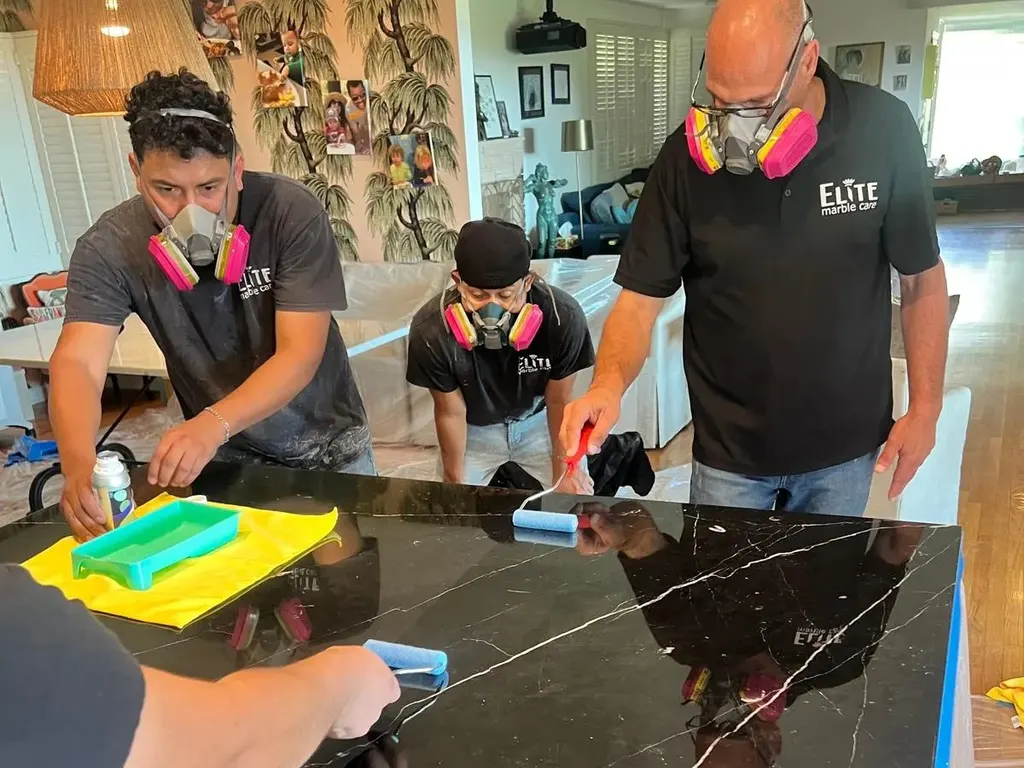
Can you tell which sealer is being applied in the article photo?
No. The owner-supplied photo shows the team working on a countertop, but the image alone does not identify the product, its chemistry or the protection it provides. Confirm the proposed system in the written scope.
Sources
Not sure which service your stone needs?
Elite Marble Care can assess the surface in person, explain the restoration sequence, and provide a free on-site estimate across Greater Los Angeles.